
University called Nilekani 'more than a business leader'.
I think instead of waiting for leaders, each of us can resolve to be a leader in his or her own right, in whatever area we chose to do.

Dharmendra Pradhan's resignation is significant because it punctures, however slightly, the perception that the Modi government never retreats under pressure. Every long-serving government eventually reaches a point where every institutional failure is identified with the leader himself. Removing the minister may have prevented that political burden from falling directly on Modi. Whether it also resolves the underlying crisis is another matter, notes Ramesh Menon.
Leading the ambitious Unique Identification Database project, Nandan Nilekani, former Infosys co-chairman, is keen to take the "best people" from the government and outside in his core team.
With the Rs 7,800-crore (Rs 78 billion) fraud at Satyam Computer leaving India's IT sector gasping for breath, Infosys chairman Nandan Nilekani sees the fiasco as a blessing in disguise, as it will make authorities enforce better regulations and auditing mechanisms for the industry.

Shiv Nadar and family donated Rs 2,708 crore (Rs 27.08 billion) in 2024-2025.
Nandan Nilekani, erstwhile CEO and a founder of Infosys Technologies Limited, who is currently co-chairman of its board of directors, offered a peek into his forthcoming book Imagining India, which he said attempts to alleviate a gap in understanding India, while delivering the kick-off Global Leader Lecture at Johns Hopkins University's School of Advanced International Studies.
Nandan Nilekani is stepping down to take up a bigger cause -- heading a government project to provide a unique identity to each of India's citizens. S Gopalakrishnan, the CEO and MD of Infosys and a co-founder of the company, tells Bibhu Ranjan Mishra what Nilekani's exit means for the company.
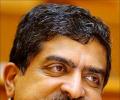
In March 2014, Nilekani quit UIDAI to try his luck in politics.

Behind nearly every major shift in IT policy in India, there was an intelligent -- and enterprisingly agile -- bureaucrat.

'Firms such as Infosys, were started by people without instantly recognisable surnames. Our success motivated numerous new entrepreneurs,' writes Nandan Nilekani in his book Imagining India.
Nandan Nilekani introduces extracts from his book, Imagining India, exclusive to rediff.com
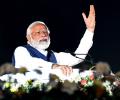
A book revolving around Prime Minister Narendra Modi's work and political and governance model with various chapters written by domain experts, his Cabinet colleagues and leading faces in different walks of life, is set to hit the bookstores next month.

As Chief Election Commissioner N Gopalaswami says, 'When one vote is cast, the machine takes twelve seconds to reactivate. So the "productivity" of the fraudsters goes down, since you can't just stuff bunches of paper into a box.' The time delay has also helped the Commission figure out when 'stuffing' has happened with a machine. 'If we spot a series where votes were cast every twelve seconds, we simply cancel that result.'
Nandan Nilekani on how IT modernised India's stock exchanges.
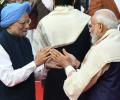
False and acrimonious debates such as Modi versus Manmohan might allow for victories that are political and partisan. But the real loser is the nation, India and Bharat, notes Arvind Subramanian, former chief economic advisor to the Modi government in its first term.
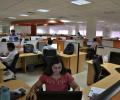
Nilekani said new-age technology markets work on a winner-takes-all basis.

Not only is your privacy stripped stark naked, says Mitali Saran, the system itself is illegal and vulnerable.
In India, the angsting over net neutrality has been loud.

'We first need to acknowledge the truth.' 'We are trying to diminish the problem and say, everything is okay and green shoots are emerging.' 'Imagine you are a doctor and not getting accurate medical reports, how do you diagnose and treat the illness?' 'We are not dealing with a terminal illness here, we are dealing with BP and cholesterol, which are imminently curable.'

Former chairman of the UIDAI Nandan Nilekani, elucidates how Aadhaar could become the spine for alternative banking and could replace government services with cash benefits.

There are unprecedented political implications of identification based on 'biological attributes of an individual', such as employed by Aadhaar, warns Gopal Krishna.

Some time before December 31, 2017, Bengaluru based Team Indus aims to land a vehicle on the moon.
